Interacting with Two Dominant Hands in AR: A Study of Aimed Motions with Real and Spatially Displaced Virtual Hands
Abstract
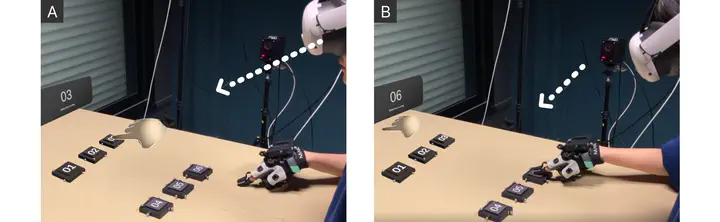
This study investigates whether people can coordinate their real dominant hand with an additional, spatially displaced virtual hand in Augmented Reality. In an aimed-motion experiment with 24 participants, real and virtual targets were alternated while virtual-hand representation (realistic hand or abstract sphere) and hand offset (20 or 40 cm) were varied. The study combines transition time, movement dynamics, trajectory deviation, proprioceptive drift, embodiment, and cognitive-load measures. Participants generally adapted the hand they used to the target modality regardless of representation and offset; detailed analyses show that a realistic virtual hand can increase embodiment while modestly affecting initiation and trajectories during the transition back to the real hand.
Experiment video

Juri Yoneyama
PhD Student
Etienne Peillard
Associate Professor
My research focuses on perception and embodied interaction in Virtual and Augmented Reality, including augmented affordances, body perception, and human-system cooperation in immersive environments.

Guillaume Moreau
Dean for Research and Innovation of IMT Atlantique

Ferran Argelaguet
Inria Research Scientist
Research scientist investigating Virtual and Augmented Reality, 3D interaction, and human perception.