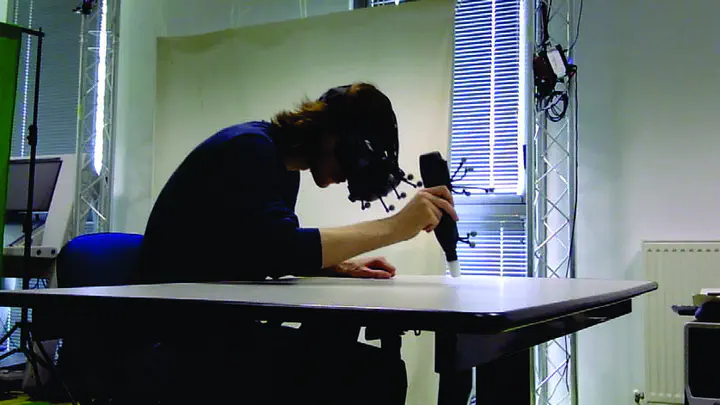
 A participant performs the pointing task with a tracked replica (Figure 1 of the article).
Abstract
A within-subject VR experiment compared three weighted tool replicas in a pointing task. Prop mass influenced error-free selection time, errors, perceived difficulty, and cognitive load: performance and user experience were significantly better with the light replica than with the heavy one.
Study at a glance
This follow-up study examines a different question from training transfer: how does the mass of a physical prop affect immediate interaction in Virtual Reality? Participants completed a within-subject pointing task with three replicas of the same tool, each with a different mass.
The experimental task
The participant selected targets in VR using a tracked tool replica. The design captured both objective performance—error-free selection time and number of errors—and subjective experience, including perceived difficulty and cognitive load.
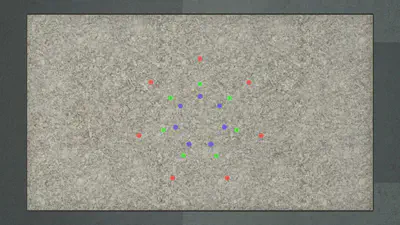
First-person view of the target-selection task used in the experiment.
Main result
Prop mass influenced both performance and experience. Participants performed significantly better with the light replica than with the heavy replica; they also reported lower difficulty and cognitive load. In contrast with the training study, this highlights that a mass mismatch can matter when the task places a premium on fast, accurate pointing.
Julien Cauquis
PhD Student in Virtual Reality

Etienne Peillard
Associate Professor
My research focuses on perception and embodied interaction in Virtual and Augmented Reality, including augmented affordances, body perception, and human-system cooperation in immersive environments.

Lionel Dominjon
Scientific Manager

Thierry Duval
Professor in Computer Sciences