Can Retinal Projection Displays Improve Spatial Perception in Augmented Reality?
Abstract
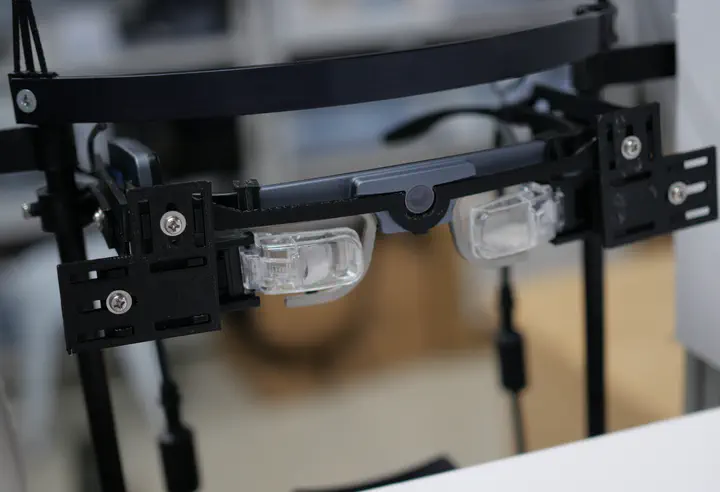
Commonly used Head Mounted Displays (HMDs) in Augmented Reality (AR), namely Optical See-Through (OST) displays, suffer from a main drawback: their focal lenses can only provide a fixed focal distance. Such a limitation is suspected to be one of the main factors for distance misperception in AR. In this paper, we studied the use of an emerging new kind of AR display to tackle such perception issues: Retinal Projection Displays (RPDs). With RPDs, virtual images have no focal distance and the AR content is always in focus. We conducted the first reported experiment evaluating egocentric distance perception of observers using Retinal Projection Displays. We compared the precision and accuracy of the depth estimation between real and virtual targets, displayed by either OST HMDs or RPDs. Interestingly, our results show that RPDs provide depth estimates in AR closer to real ones compared to OST HMDs. Indeed, the use of an OST device was found to lead to an overestimation of the perceived distance by 16%, whereas the distance overestimation bias dropped to 4% with RPDs. Besides, the task was reported with the same level of difficulty and no difference in precision. As such, our results shed the first light on retinal projection displays’ benefits in terms of user’s perception in Augmented Reality, suggesting that RPD is a promising technology for AR applications in which an accurate distance perception is required.
Why this matters
Conventional optical see-through headsets present virtual imagery at a fixed focal distance. This accommodation conflict is a plausible contributor to the distance misperceptions often observed in AR. Retinal Projection Displays offer a different optical principle: virtual content remains in focus rather than being tied to a single focal plane.
Study at a glance
The experiment compared egocentric distance estimates for real and virtual targets seen through an optical see-through headset and through a Retinal Projection Display. It measured both the accuracy and precision of the judgments, as well as the reported difficulty of the task.
Key findings
- With the optical see-through display, virtual targets were overestimated by 16%.
- With the Retinal Projection Display, the overestimation fell to 4%.
- The improvement in accuracy did not come with a detectable loss of precision or increase in reported task difficulty.
The result provides early evidence that display optics can be a practical lever for improving spatial perception in AR applications that require accurate depth judgments.
In the doctoral research
This publication closes the experimental arc of the doctoral research on perceptual biases in Mixed Reality by testing a device-level route to reduce a perceptual bias.

Etienne Peillard
Associate Professor
My research focuses on perception and embodied interaction in Virtual and Augmented Reality, including augmented affordances, body perception, and human-system cooperation in immersive environments.

Yuta Itoh
Associate Professor of Computer Science
Associate Professor working on Augmented Reality, visual augmentation, and near-eye display technologies.

Guillaume Moreau
Dean for Research and Innovation of IMT Atlantique

Jean-Marie Normand
Professor of Virtual and Augmented Reality
Professor working on perception, embodiment, and interaction in Virtual, Augmented, and Mixed Reality.

Anatole Lécuyer
Director of Research
Inria Director of Research working on Virtual Reality, 3D interaction, haptics, and brain-computer interfaces.

Ferran Argelaguet
Inria Research Scientist
Research scientist investigating Virtual and Augmented Reality, 3D interaction, and human perception.