AR Filters Change How We Think, Not Who We Like: Effects of Role and Age Embodiment on Cognitive Performance and Age Bias
 Scientist-attire filter used in the age-and-role embodiment study.
Abstract
We conducted a mixed-design study with 105 analysed participants using Snapchat face filters to independently manipulate apparent age (no change versus older) and role (no change versus scientist attire). Participants completed a mental-arithmetic task, an age-bias Implicit Association Test, explicit age-attitude measures, and an embodied-identification questionnaire. Neither virtual aging, scientific attire, nor their combination produced reliable changes in implicit or explicit age bias relative to the control condition. Within scientist-attire conditions, higher embodied identification showed a small positive association with math performance. The results indicate that brief AR self-transformations may affect cognitive performance without reproducing the bias reductions reported in comparable VR embodiment studies.
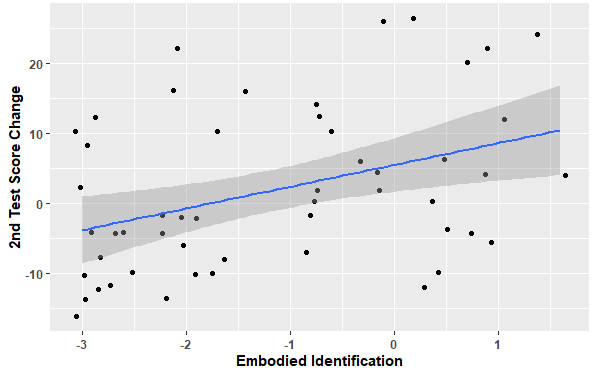
The featured image shows the smartphone-based AR setting: a self-view augmented with scientist attire. Together with the result plot, it distinguishes the study’s two questions - whether virtual aging and role cues affect age bias, and whether identification with those cues relates to cognitive performance.

Marie Jarrell
Postdoc
Hi, I’m Marie, a researcher, designer, and staunch advocate for all things related to video games, VR simulations, and overall digital interactive experiences. A graduate of Clemson University with a PhD in Human-Centered Computing and two Master degrees in Digital Production Arts and Computer Science. I currently utilize my numerous artistic and scientific skills to build video games and research their impact.

Etienne Peillard
Associate Professor
My research focuses on perception and embodied interaction in Virtual and Augmented Reality, including augmented affordances, body perception, and human-system cooperation in immersive environments.