Using Identification with AR Face Filters to Predict Explicit and Implicit Gender Bias
 Gender-manipulated Snapchat face filters used to examine identification and gender bias.
Abstract
We examined whether identification with gender-manipulated Snapchat face filters is associated with implicit and explicit gender bias. In a controlled study, 119 participants used a no-change, male-presenting, or female-presenting filter and completed measures of implicit association, androcentrism, gender-norm agreement, and embodied identification. The filters did not reliably change implicit gender associations or androcentrism. Identification was, however, associated with explicit agreement with gendered norms, with patterns differing according to participants’ gender and the filter used. The findings show that AR face filters are not neutral self-representations, while cautioning against universal bias-reduction interventions based on short AR transformations.
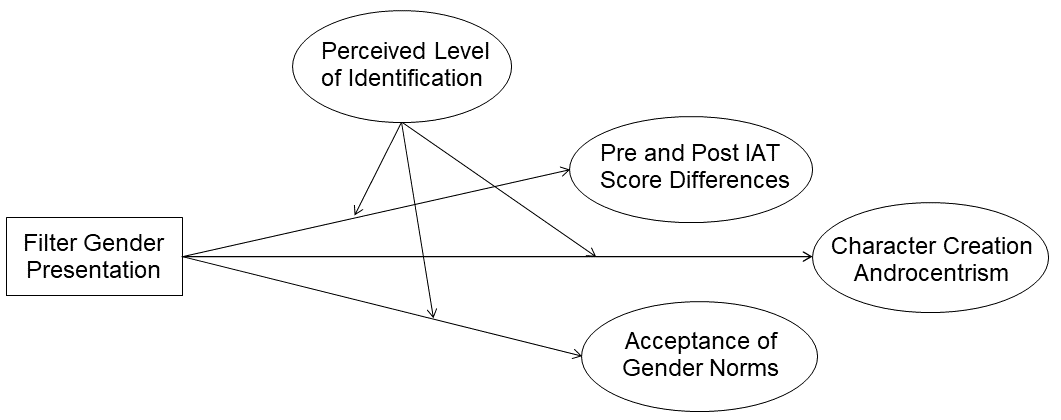
The diagram makes the article’s central point visible: AR self-transformation is not treated as a single intervention. Its effects must be understood in relation to the particular filter, the person using it, and the outcome being measured.

Marie Jarrell
Postdoc
Hi, I’m Marie, a researcher, designer, and staunch advocate for all things related to video games, VR simulations, and overall digital interactive experiences. A graduate of Clemson University with a PhD in Human-Centered Computing and two Master degrees in Digital Production Arts and Computer Science. I currently utilize my numerous artistic and scientific skills to build video games and research their impact.

Etienne Peillard
Associate Professor
My research focuses on perception and embodied interaction in Virtual and Augmented Reality, including augmented affordances, body perception, and human-system cooperation in immersive environments.