Influence of virtual objects' shadows and lighting coherence on distance perception in optical see-through augmented reality
Abstract
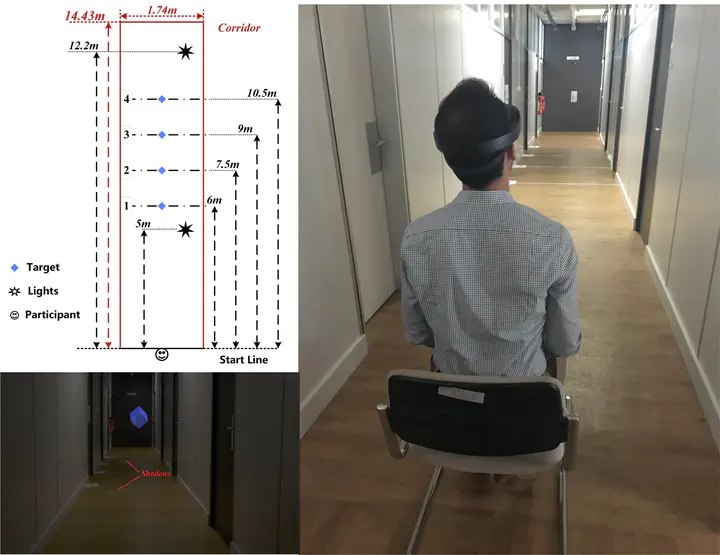
This paper focuses on how virtual objects’ shadows as well as differences in alignment between virtual and real lighting influence distance perception in optical see-through (OST) augmented reality (AR). Four hypotheses are proposed: (H1) Participants underestimate distances in OST AR; (H2) Virtual objects’ shadows improve distance judgment accuracy in OST AR; (H3) Shadows with different realism levels have different influence on distance perception in OST AR; (H4) Different levels of lighting misalignment between real and virtual lights have different influence on distance perception in OST AR scenes. Two experiments were designed with an OST head mounted display (HMD), the Microsoft HoloLens. Participants had to match the position of a virtual object displayed in the OST-HMD with a real target. Distance judgment accuracy was recorded under the different shadows and lighting conditions. The results validate hypotheses H2 and H4 but surprisingly showed no impact of the shape of virtual shadows on distance judgment accuracy thus rejecting hypothesis H3. Regarding hypothesis H1, we detected a trend toward underestimation; given the high variance of the data, more experiments are needed to confirm this result. Moreover, the study also reveals that perceived distance errors and completion time of trials increase along with targets’ distance.
Why this matters
Virtual content in optical see-through AR must coexist with the lighting of the physical world. Shadows and illumination can make an object appear anchored in the scene, but their contribution to distance perception was still poorly understood. This work separates the effects of shadow realism, shadow shape, and the alignment between virtual and physical lights.
Study at a glance
In two Microsoft HoloLens experiments, participants aligned a virtual cube with physical targets at different distances. The studies compared several virtual-shadow conditions and several degrees of misalignment between real and virtual lighting.
Key findings
- The realism of the shadow and the coherence of virtual lighting with the physical scene affected distance judgments.
- Changing the shadow’s shape alone did not improve distance-judgment accuracy.
- Errors increased with target distance; the data suggested underestimation in optical see-through AR, but the variability did not support a firm conclusion.
The study shows that visual integration is not merely cosmetic: lighting decisions can influence the spatial information users derive from an augmented scene.
In the doctoral research
This work is the scene-design contribution of the doctoral research on perceptual biases in Mixed Reality, identifying controllable visual cues that shape AR distance perception.

Etienne Peillard
Associate Professor
My research focuses on perception and embodied interaction in Virtual and Augmented Reality, including augmented affordances, body perception, and human-system cooperation in immersive environments.

Jean-Marie Normand
Professor of Virtual and Augmented Reality
Professor working on perception, embodiment, and interaction in Virtual, Augmented, and Mixed Reality.