Investigating Whether the Mass of a Tool Replica Influences Virtual Training Learning Outcomes
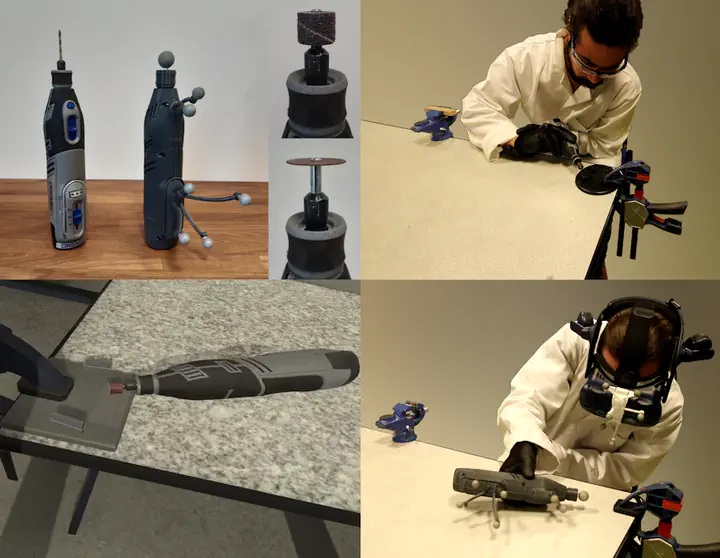 The real rotary tool, its tracked replica, and the real and virtual phases of the training protocol.
Abstract
Virtual Reality (VR) has emerged as a promising solution to address the pressing concern of transferring know-how in the manufacturing industry. Making an immersive training experience often involves designing an instrumented replica of a tool whose use is to be learned through virtual training. The process of making a replica can alter its mass, making it different from that of the original tool. As far as we know, the influence of this difference on learning outcomes has never been evaluated. To investigate this subject, an immersive training experience was designed with pre and post-training phases under real conditions, dedicated to learning the use of a rotary tool. 80 participants took part in this study, split into three groups: a control group performing the virtual training using a replica with the same mass as the original tool (m = 100%), a second group that used a replica with a lighter mass than the original tool (m = 50%), and a third group using a replica heavier than the original tool (m = 150%). Despite variations in the mass of the replica used for training, this study revealed that the learning outcomes remained comparable across all groups, while also demonstrating significant enhancements in certain performance measures, including task completion time. Overall, these findings provide useful insights regarding the design of tool replicas for immersive training.
Why this matters
Instrumenting a real tool for Virtual Reality training often changes its mass. This study asks whether that physical mismatch compromises what matters most: the learner’s ability to perform the gesture afterwards in real conditions.
Study at a glance
Eighty participants completed a three-stage protocol: a real pre-training assessment, immersive training with a tracked replica, then a real post-training assessment. The experience covered three gestures with a one-handed rotary tool: cutting, drilling, and sanding.
The original tool weighed 624 g. The three replica conditions were balanced and weighted to 312 g (50%), 624 g (100%), and 936 g (150%). The study combined real-task performance measures with cognitive load, usability, and perceived-learning questionnaires.
Main result
Across the tested conditions, learning outcomes remained comparable despite the changes in replica mass. Participants also improved on selected real-task measures, including task-completion time. Within the 300–900 g range and for these tasks, replica mass was therefore not a decisive factor for the measured learning outcomes.
This result gives designers practical room to accommodate tracking and fabrication constraints—but it should not be overgeneralised to heavier tools, highly precise gestures, or tasks that require stronger proprioceptive or haptic feedback.

Julien Cauquis
PhD Student in Virtual Reality

Etienne Peillard
Associate Professor
My research focuses on perception and embodied interaction in Virtual and Augmented Reality, including augmented affordances, body perception, and human-system cooperation in immersive environments.

Lionel Dominjon
Scientific Manager

Thierry Duval
Professor in Computer Sciences