Perception and Representation of Urban Night Lighting Ambiances in Virtual Reality
CIFRE PhD research project with L’Observatoire de la Nuit

CIFRE doctoral research · 2025–2028
Immersive tools for experiencing, comparing, and discussing sustainable urban night lighting before it is built.
Industrial doctoral collaborationL'Observatoire de la Nuit × AAU-CRENAU × LS2NA CIFRE project connecting urban-lighting practice, spatial-ambiance research, and immersive-systems expertise.
Abstract
Urban-lighting projects are often assessed through quantitative standards and energy targets, while their effects on the human experience of the night, biodiversity, and light pollution receive less attention. They are also difficult to discuss with decision-makers when meetings take place during daytime and proposed nocturnal ambiances cannot be experienced directly.
This PhD project develops immersive tools for representing and evaluating urban night lighting. Virtual-Reality simulations, perceptual studies, and photometric models are combined to help stakeholders compare lighting scenarios, understand their environmental effects, and make more informed decisions about sustainable lighting design.
CIFRE doctorate
Design and renovation projects
Perception beyond brightness alone
Research challenges
Perceiving nocturnity
Characterize the scene-dependent sense of being at night beyond a simple reduction in brightness.
Low-light vision
Study how mesopic and scotopic visual effects influence the perception of virtual nocturnal environments.
Representing light pollution
Calculate and visualize direct, reflected, and scattered light so environmental impacts can be considered during design.
Supporting decisions
Develop realistic, schematic, and false-colour representations for lighting professionals, public authorities, and stakeholders.
Research approach
Measure experience
Describe nocturnity and the perceptual cues that make an urban scene feel convincingly nocturnal.
Simulate light
Model light distribution, night-vision effects, and environmental impacts in immersive urban scenes.
Compare scenarios
Use experiments and professional feedback to identify representations that support informed discussion and choice.
Transfer to practice
Integrate validated approaches into Obscura for projects that need to balance ambience, safety, energy, and biodiversity.
Current research
The project has introduced the concept of nocturnity, defined as the feeling of being at night elicited by a scene. A first 42-item questionnaire organizes this experience into perceptual, activity-related, and inner-state dimensions. Its content was reviewed by urban-lighting experts and is being evaluated through Virtual-Reality experiments and broader image-based studies.
This metric provides a basis for future experiments on the simulation of night vision, including colour desaturation, reduced visual acuity, and luminance shifts. The research also examines physical presence, cybersickness, chronotype, and fatigue as factors that may influence responses to virtual nocturnal scenes.
Industrial developments
Research prototypes are integrated into Obscura, L’Observatoire de la Nuit’s real-time lighting-simulation software. Developments include photon mapping for estimating indirect light, visualisation of photometric distributions, support for architectural DXF plans, and assistance in selecting luminaires for street-lighting renovation. These tools connect quantitative photometric calculations with the qualitative experience of urban night environments.
Expected contribution
Provide a shared language and visual toolkit for comparing lighting proposals before installation—so perceptual quality and environmental sobriety can be discussed alongside technical performance.
People involved
PhD student

Anthony Le Gourriérec
Anthony investigates how Virtual Reality can make urban night-lighting ambiances perceptible, discussable, and environmentally informed.
View Anthony’s profileAcademic supervision

Myriam Servières
Directs the research on urban digital models, spatial perception, and nocturnal ambiances.



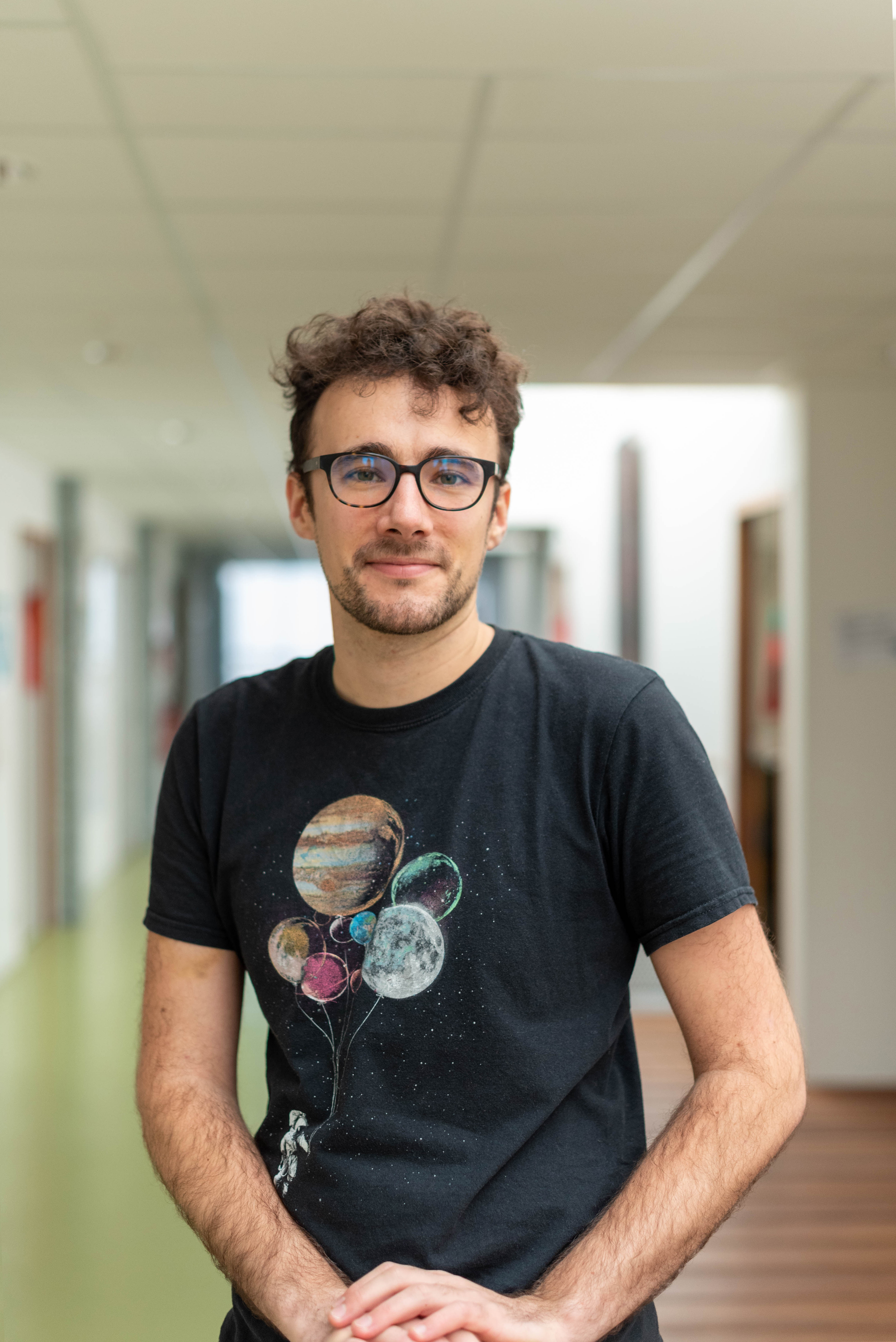
Étienne Peillard
Contributes immersive systems, experimental methods, and perception-centred interaction research.

Industrial supervision

Nicolas Houel
Brings urban-planning, lighting-sobriety, and field-case expertise through the Obscura simulation environment.

Partners
- L’Observatoire de la Nuit provides the industrial context, lighting expertise, field cases, and the Obscura simulation environment.
- AAU-CRENAU contributes expertise in urban digital models, spatial perception, and the study of architectural and urban ambiances.
- LS2N — PACCE contributes immersive systems, interaction methods, and experimental expertise in Virtual and Augmented Reality.
Publications
Funding
This research project is carried out through a Convention Industrielle de Formation par la Recherche (CIFRE) managed by the French National Association for Research and Technology (ANRT).