Distance Perception in Mixed Reality
PhD Thesis — Toward a Characterization of Perceptual Biases
Research question
Doctoral research · 2016–2020
Virtual and Augmented Reality can place digital content convincingly in space, yet the distances users perceive are not always the distances that are rendered or physically present. This doctoral research examined where these mismatches come from and which levers can make Mixed Reality experiences more perceptually reliable.
The thesis follows distance perception from the geometry of the observer’s visual space to the composition of an augmented scene and, finally, to the display itself. Together, its contributions show that distance judgments depend on more than an object’s physical location: they are shaped by its direction relative to the observer, the real–virtual relationship between objects, the coherence of visual cues, and the optical properties of the device.
Thesis record
Read or watch the defense
The official thesis record, abstract and access information are available on theses.fr.
View the thesis recordContributions
1 · Virtual Reality
Distance perception is anisotropic
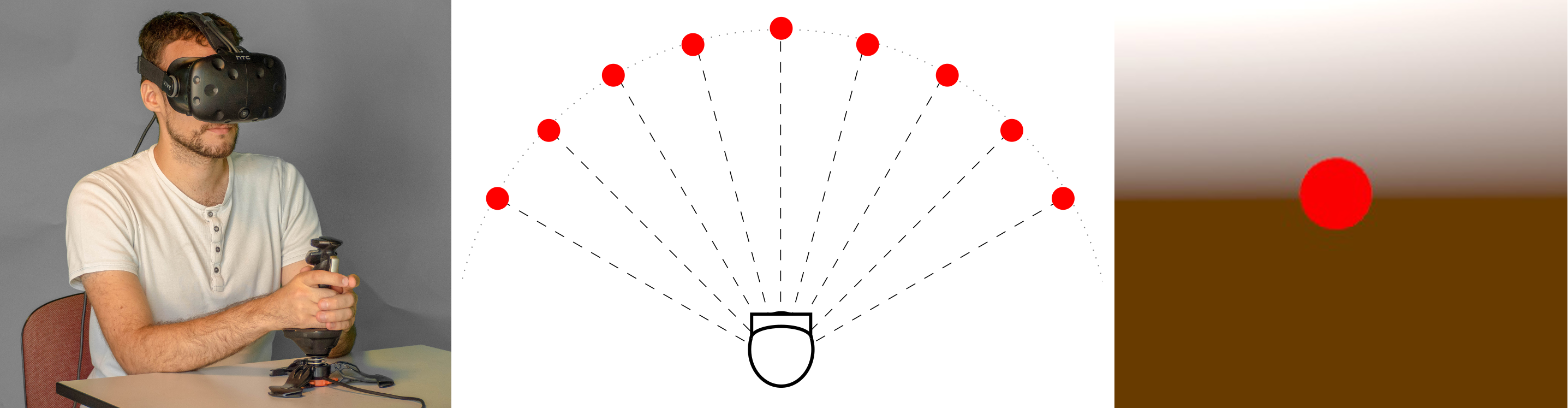
Across four psychophysical experiments with 85 participants, virtual objects placed to the side were systematically perceived as farther away than objects in front of the observer. The bias increased with the viewing angle and persisted despite changes in field-of-view placement and scene richness.
2 · Augmented Reality
Real–virtual layouts reshape exocentric judgments
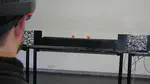
When estimating the distance between two objects rather than the distance to themselves, participants overestimated distances by about 20%. The mixed real–virtual conditions also revealed a directional asymmetry, motivating a more relational account of AR perception.
3 · Scene design
Lighting coherence matters more than shadow shape
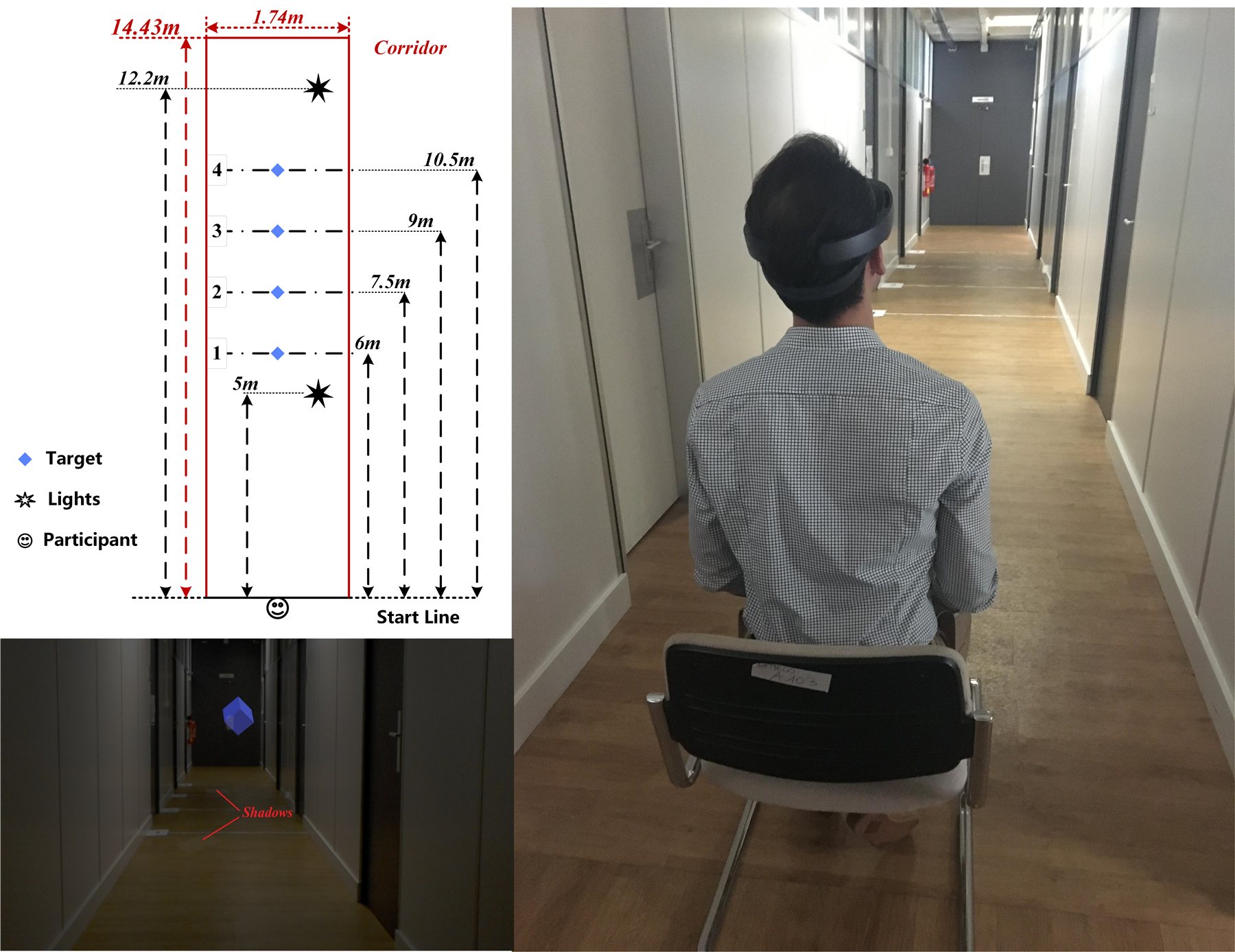
Two optical see-through AR experiments tested shadows and illumination. Distance judgments changed with the realism of the shadow and with mismatches between virtual and physical lighting, whereas changing shadow shape alone did not improve accuracy.
4 · Display technology
Retinal projection reduced a depth bias
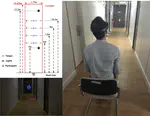
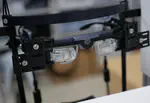
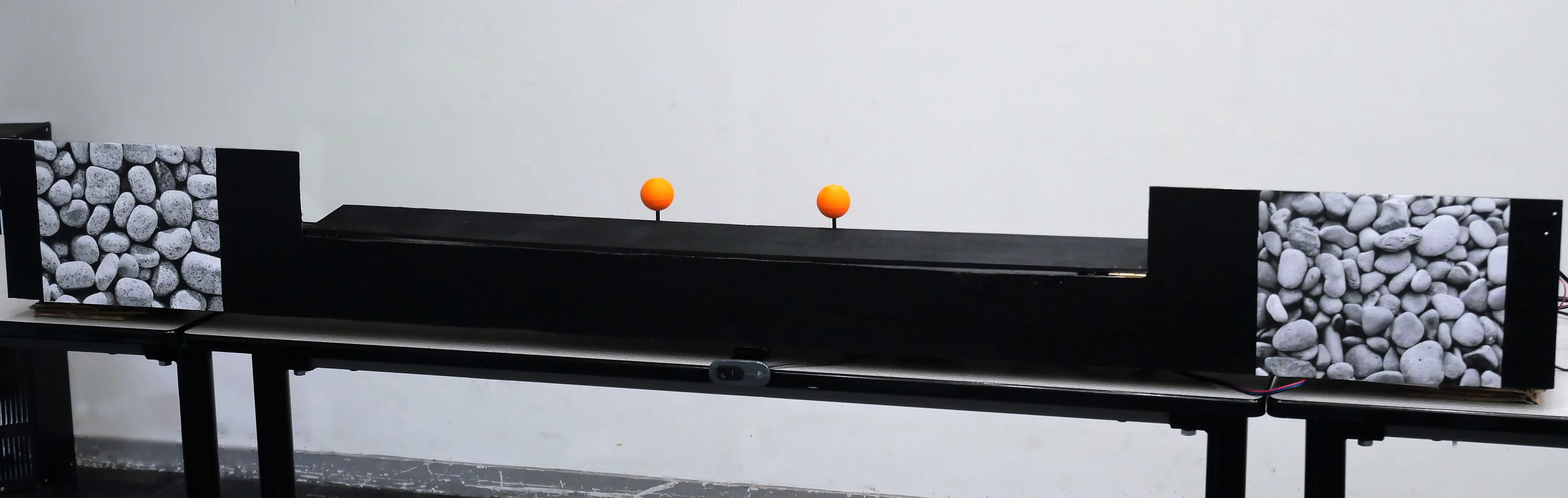
The first evaluation of egocentric distance perception with retinal projection displays found estimates closer to real-world performance: the overestimation observed with an optical see-through headset fell from 16% to 4%, without a loss of precision.
From visual space to display design
The four studies form a single research trajectory. The first identifies a bias intrinsic to the observer’s spatial representation; the second asks how that representation behaves when real and virtual objects coexist; the third isolates scene cues that can alter the judgment; and the fourth tests whether the display’s focal behavior itself can mitigate the bias. This progression turns the thesis from a catalogue of effects into a set of practical questions for XR designers: where should content be placed, how should it be visually integrated, and which display constraints need to be considered?


Etienne Peillard
Associate Professor
My research focuses on perception and embodied interaction in Virtual and Augmented Reality, including augmented affordances, body perception, and human-system cooperation in immersive environments.