Augmented affordances and embodied interaction
PAEIAR — Perception of Affordances and Embodied Interaction in Augmented Reality

ANR JCJC project at IMT Atlantique / LS2N, studying how augmented reality changes the action possibilities people perceive in their physical surroundings.
At a glance
Augmented Reality (AR) does more than place digital content beside the physical world: it can change what an object appears to allow us to do. A solid object may seem warmer, softer, easier to grasp, or newly actionable when virtual cues alter its appearance, location, or response to movement. PAEIAR studies these mixed affordances—action possibilities that emerge from the combination of physical and digital information.
The project asks how visual and spatial AR cues reshape perception before, during, and after action. Its goal is to provide empirical foundations and design principles for AR interfaces that guide gestures clearly, subtly, and coherently.
Research programme
PAEIAR brings together experimental psychology, human–computer interaction, and AR engineering. Rather than treating augmentation as a neutral layer, the project treats it as a perceptual intervention: each visual change can influence object interpretation, motor preparation, and the gesture that follows.
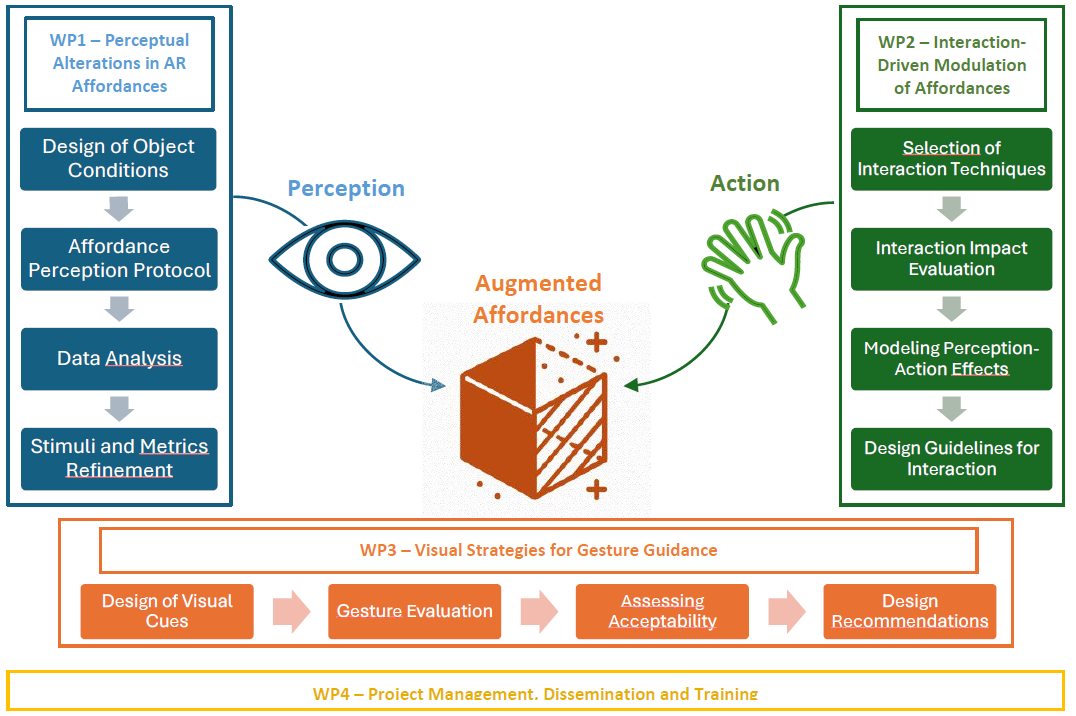
Characterising perceptual change
Measure how visual AR transformations affect the properties people attribute to physical and virtual objects, and the actions they expect those objects to support.
Understanding interaction-driven effects
Examine how direct manipulation, tangible interaction, and indirect control reshape affordances through the action itself.
Designing gesture guidance
Develop and evaluate visual strategies that steer movement through perceived affordances rather than explicit instruction.
Together, these work packages trace a full perception–action loop: from how an augmented object is interpreted, through the interaction it invites, to the gesture it can help guide in a real-world task.
Expected outcomes
The project will deliver experimental protocols, behavioural datasets, models of mixed affordances, and practical guidelines for designing perceptually grounded AR experiences. These outcomes are intended to support both fundamental research on embodied perception and the design of intelligible mixed-reality systems.
Yutaro’s doctoral research
PhD research · core contribution to PAEIAR
The PAEIAR programme provides the wider scientific framework. Within it, Yutaro Tanaka investigates a focused question: how do the visible material and physical properties of augmented objects change the actions people believe they can perform? His doctoral work makes the project’s central idea experimentally concrete by varying what an object looks and feels like in AR, then measuring changes in perceived affordances and interaction.
Featured publication
IEEE Transactions on Visualization and Computer Graphics · 2026
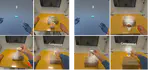
A first study tests how an object’s physicality and thermal appearance in AR influence the actions users perceive it to afford.
Project team
PAEIAR connects expertise in embodied interaction, experimental psychology, and the perceptual evaluation of Augmented Reality. Étienne Peillard leads the project; Yutaro Tanaka’s doctoral research is its main experimental thread.
Étienne Peillard
Étienne leads PAEIAR and its research on how augmented representations reshape perception, action, and the affordances of objects in mixed environments.


Yutaro Tanaka
Yutaro’s doctoral research makes the project’s central question testable: how visual AR cues change the properties people attribute to objects and the actions they expect those objects to support.
- studies how physicality and thermal appearance shape perceived affordances;
- measures how visual object properties influence action preparation and interaction; and
- develops evidence for perceptually grounded gesture guidance in AR.
Doctoral co-supervision
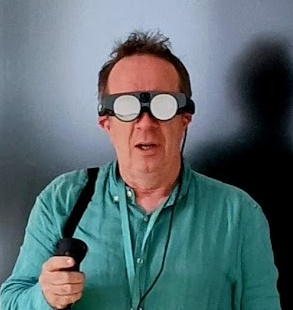
Gilles Coppin
Contributes expertise in human–computer interaction, affective perception, and experimental methods for studying how people interpret and act on augmented objects.


Nathalie Le Bigot
Contributes expertise in perception–action interactions and cognitive evaluation, grounding the doctoral experiments in cognitive psychology.

Funding

French National Research Agency · AAPG 2025 · JCJC schemePAEIAR is funded for 42 months by the French National Research Agency (ANR).